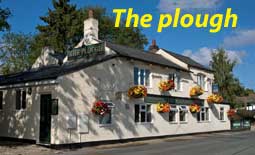
Entertainment at The
PloughThe Plough became another place of entertainment. Many an
evening I would help Frank Morton pull the pints, especially when he had an
attack of gout. Sometimes I would play the piano for a sing-song, not too
expertly I fear, and would be relieved to find that some soldier could play
much better.
Searchlight in Bullbaiters
The village had a permanent searchlight post in Bullbaiters lane. The
occupants were adopted by the villagers. My mother would billet their wives
for a weekend, and I remained in contact with some of the wives for years
afterwards.
Guinea pigs at Hyde House
Hyde House was used as a temporary rest home for Sir Archibald MacIndoe's
"Guinea Pigs". These were badly burned aircrew needing plastic surgery, and
they came here between operations. Frank Morton advised me not to go to the
Plough some evenings because some of these men were "not a pretty sight". I
went all the same and was not bothered by what I saw.
Bombs rain on Hyde Heath
My sister Grace (who died recently) eventually joined the Women's Land
Army, but at this time was an ARP volunteer. She was on duty the night a
string of bombs were jettisoned onto the village, believed to be from a
German plane aiming to destroy the searchlight post.
This was our first experience of bombing. No houses took a direct hit, but
the explosions blew out many doors and windows. Rumour said that six bombs
were dropped but only five exploded. Despite a search the sixth was never
found.
Uncle Sam in Pipers Wood
In the months leading up to D-Day, Pipers Wood camp was full of
Americans. Again the villagers made them welcome. I corresponded with the
wife of one of the lads, in Newhaven Connecticut, and she sent me some
nylons. They were the first pair I ever wore. I took them to show the girls
at work and was the envy of all. I dared not actually wear them to work
then, but of course they got worn eventually and I cried my eyes out when at
last they wore out. I found the Americans very polite, and none of them put
a foot wrong. One of our girls went to America as a G1 bride.
After the Americans left, the camp was used for the rehabilitation of our
returning prisoners of war. The WVS sewed flashes to their new uniforms and
made what alterations were necessary so that they would look smart when
returning to their regiments. I helped with this work, as I had
certain sewing abilities.
It was during this time that the "Stars In Battledress" show was put on
at the camp. The WVS and their helpers including myself were invited. The
stars I remember best were Max Bygraves and Terry-Thomas.
Food
Almost everything was rationed but in Hyde Heath we did pretty well. My
mother got on well with the army cooks. She met them when working in the
hall canteen, and she billeted service wives for weekends. So somehow we
never seemed to go really short of food.
During the lunch hour some of us would cycle to the British Restaurant in
White Lion Road, Amersham, now the Amersham Common Village Hall. For
fourpence I could get a fairly good meal. There was Woolton Pie, which
seemed to have everything chucked into it, cheese flan, or scrambled dried
egg on toast. It all went down well. The tea ration was eked out by adding a
pinch of bicarbonate of soda to the pot, thus making the tea stronger.
In many ways the war did the village some good. People here became more
open-minded. After all, there was a world outside Hyde Heath !
Irma

 Apart
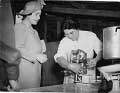
from all this entertainment, villagers were busy helping the war effort in
many ways. The WI set up a jam-making unit in the kitchen of the hall. Some
people say that it was the spoilt jam going down the drains that eventually
blocked them, but, being wartime, it could have been other things. Home
canning took place at the Wick (now Cedar Ridge). Here Dr Sybil Welsh set up
the canning unit, and the whole thing was operated by my mother, with WI
members helping during the busy fruit seasons. Most of the fruit for jam and
canning was grown locally. The gardener and I picked plums from the Wick
orchard until we were sick of the sight of them.
Apart
from all this entertainment, villagers were busy helping the war effort in
many ways. The WI set up a jam-making unit in the kitchen of the hall. Some
people say that it was the spoilt jam going down the drains that eventually
blocked them, but, being wartime, it could have been other things. Home
canning took place at the Wick (now Cedar Ridge). Here Dr Sybil Welsh set up
the canning unit, and the whole thing was operated by my mother, with WI
members helping during the busy fruit seasons. Most of the fruit for jam and
canning was grown locally. The gardener and I picked plums from the Wick
orchard until we were sick of the sight of them.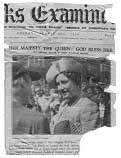 Queen
Elizabeth now the Queen Mother visited Hyde Heath and other nearby villages
in 1940, to see what was being produced on the Home front by the Wl. All the
villagers turned out for her visit. It was a lovely day as the
schoolchildren lined up to see her proceed down Brays Lane to the Wick . The
village's Red Cross contingent were presented to Her Majesty. One of them,
Mrs Frances Clark, still lived in Hyde Heath until she died recently.
Queen
Elizabeth now the Queen Mother visited Hyde Heath and other nearby villages
in 1940, to see what was being produced on the Home front by the Wl. All the
villagers turned out for her visit. It was a lovely day as the
schoolchildren lined up to see her proceed down Brays Lane to the Wick . The
village's Red Cross contingent were presented to Her Majesty. One of them,
Mrs Frances Clark, still lived in Hyde Heath until she died recently.